How Active Noise Cancellation Solves the Microsecond Latency Trap in Everyday Audio
-
Posted in : Uncategorized:
- On : Sep 08, 2026
The Invisible Speed Limit Inside Your Earbuds
Active noise cancellation is often described as a simple act of wave inversion. A microphone detects unwanted sound, a processor creates an opposite waveform, and a loudspeaker emits it into the ear. That description is directionally correct, but it hides the engineering problem that determines whether ANC works well or produces artifacts. The system must measure, calculate, and reproduce acoustic pressure quickly enough for the anti-noise to arrive at the ear at the correct time. In practical terms, ANC is an electro-mechanical timing system, not a magic eraser.
The challenge becomes clearer in a compact earbud. Sound travels through air at roughly 343 metres per second under ordinary conditions, so a few millimetres represent only a few tens of microseconds. That seems generous until microphone response, analogue-to-digital conversion, filtering, computation, digital-to-analogue conversion, amplifier behaviour, and driver movement are included. Modern systems also have to manage buses, footsteps, speech, traffic, construction impacts, and wind, rather than the relatively stable engine drone that shaped early aviation ANC. For listeners who also care about reliable, low-latency electronics, the same principle applies as with any carefully engineered system: specialized audio processing must be matched to the physical load it controls.
The Physics of Acoustic Flight Paths and the Microsecond Budget
The first constraint is geometry. If an exterior microphone sits 10 millimetres farther from the ear canal entrance than the earbud driver, an incoming pressure wave reaches those points at different times. At the speed of sound, 10 millimetres corresponds to about 29 microseconds. A 30 millimetre path difference corresponds to approximately 87 microseconds. The numbers are small, but at high frequencies a small time error represents a meaningful phase error. At 10 kilohertz, one complete cycle lasts only 100 microseconds, so an error of 25 microseconds shifts the waveform by a quarter of a cycle.
ANC therefore has a finite timing budget rather than an unlimited opportunity to calculate a perfect inverse. Every stage consumes part of that budget. The microphone must convert air pressure into an electrical signal, the converter must sample it, the DSP must estimate the required response, and the output stage must move the driver. Filters also introduce group delay, particularly when they are designed to maintain stable behaviour across a broad frequency range. The following simplified allocation illustrates why low-frequency cancellation is generally easier than high-frequency cancellation.
| Pipeline stage | Typical engineering concern | Effect on cancellation |
|---|---|---|
| Microphone sensing | Sensor response, placement, wind exposure | Determines how early and accurately noise is observed |
| Conversion | Sampling and quantisation delay | Adds fixed latency and limits bandwidth |
| DSP filtering | Algorithm complexity and group delay | Shapes phase accuracy, stability, and frequency range |
| Output conversion and amplification | Buffering, amplifier settling, output drive | Delays the corrective signal |
| Driver displacement | Diaphragm inertia and acoustic loading | Determines how quickly pressure actually changes |
Cancellation effectiveness depends on both timing and the relationship between the unwanted and corrective waves at the eardrum. A phase error that is tolerable at 100 hertz can be destructive to performance at 5 or 10 kilohertz. This is why passive sealing remains important: a physical barrier reduces incoming energy without consuming computational time. The historical development of ANC, from early anti-sound concepts to aviation headsets, reflects this division of labour. Electronics handle predictable low-frequency energy, while physical isolation and careful acoustic design address higher-frequency content. Background on that evolution is available in this technical account of active noise cancellation history.
Feedback, Feedforward, and Hybrid Architectures in Urban Noise
Feedforward ANC places a microphone on the outside of the earcup or earbud. It hears environmental noise before that noise reaches the ear, giving the processor an opportunity to prepare the anti-noise. This arrangement is valuable for changing external conditions, but it is exposed to wind, handling noise, microphone mismatch, and uncertainty about the final acoustic path. Feedback ANC places a microphone inside the earcup or near the ear canal. It measures the residual sound that actually remains after passive isolation and driver output, allowing the system to correct errors caused by fit, leakage, and driver variation. Its weakness is that the observation occurs later, leaving less time to respond.
A hybrid design combines both approaches because urban noise is rarely uniform. The exterior microphone provides advance information, while the interior microphone verifies the result and corrects the real pressure field. The two signals must be managed carefully. Excessive loop gain can cause instability or audible coloration, while an overly cautious controller may leave substantial noise untreated. The design also needs safeguards for changing ear geometry, blocked vents, loose fit, and wind turbulence. Research into smarter hearing technology similarly identifies latency, power consumption, sensor integration, and on-device adaptation as linked engineering constraints rather than isolated features. A useful overview appears in high-efficiency hearing processing.
- An exterior microphone detects an approaching transient, such as a bus brake hiss or a passing vehicle.
- The signal is conditioned and converted into a digital representation without unnecessary buffering.
- The DSP estimates the noise waveform, the acoustic transfer path, and the phase required for corrective output.
- The output stage drives the miniature transducer with the calculated anti-noise signal.
- An interior microphone measures the remaining pressure and feeds the error back into the control loop.
This progression explains why ANC cannot cancel every sound equally well. A sudden high-frequency click may reach the ear before the system can establish a reliable estimate, especially if it arrives from an unexpected direction. A low-frequency train rumble, however, has a long waveform period and is easier to model before its energy becomes intrusive. Hybrid systems improve the odds, but they do not repeal causality. The practical objective is controlled attenuation across the frequencies and situations where the architecture has adequate observation time.
Silicon Innovations and Edge Processing at Sub-Millisecond Speeds
The processing platform determines how much of the acoustic timing budget remains available. General-purpose computing can perform audio calculations, but dedicated audio DSPs are designed to execute filtering, mixing, beamforming, echo control, and feedback loops with predictable timing. Newer systems may add neural processing units or deep-learning accelerators for classification and adaptive suppression. These blocks can identify whether the environment contains speech, traffic, wind, or machinery without sending raw audio to a remote service. For ANC, local processing matters because a network round trip would be incompatible with microsecond and millisecond control requirements.
Compact hardware must also balance responsiveness against battery life and heat. More computation can improve environmental adaptation, but continuous high-performance operation drains a small cell quickly. Integrated memory and processing reduce data movement, while quantised models, wake-on-sound circuits, dynamic power gating, and dedicated low-power cores allow the system to scale effort according to conditions. Practical silicon choices include:
- Dedicated DSP paths for fixed-latency filtering and control loops.
- Integrated memory to reduce transfers between separate chips.
- Low-power sensor monitoring that activates heavier processing only when needed.
- Neural accelerators for classifying noise and selecting suitable suppression profiles.
- Predictive filters that estimate the next portion of a waveform rather than waiting for every sample to arrive.
Prediction is particularly useful when physical placement creates a delay between the sensing microphone and the ear. If the system recognises a recurring waveform or a measurable transient trajectory, it can estimate what the pressure will be when it reaches the canal. Prediction must be constrained, however. An incorrect estimate can add sound instead of removing it, and a rapidly changing urban scene may defeat a model trained on regular patterns. The strongest architecture therefore combines conventional low-latency DSP, sensor feedback, and selective machine learning rather than relying on a neural model alone.
Transducer Mechanics and the Final Millimeter
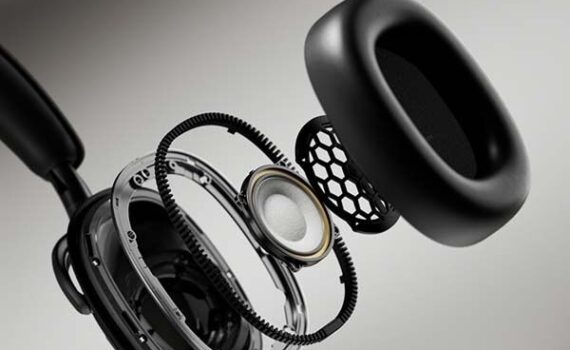
Even a perfect digital calculation is ineffective if the driver cannot produce the required pressure quickly. A miniature diaphragm has mass, compliance, damping, and an acoustic load imposed by the ear canal and enclosure. These factors create a transfer function that varies with frequency. The voice coil must generate force rapidly, but excessive force or insufficient damping can produce overshoot, ringing, distortion, or instability in the feedback loop. Engineers therefore tune the diaphragm material, suspension, magnet system, and enclosure together. The target is not simply maximum output; it is predictable displacement with controlled phase.
The final millimetre is also the most variable. Ear canals differ in shape, volume, and impedance, while earbuds shift as the wearer walks or speaks. A small leak can reduce low-frequency isolation and change the acoustic path that the controller is trying to manage. Interior microphones help detect the resulting error, but they cannot fully compensate for every mechanical change. Good fit, stable ear tips, low wind sensitivity, and appropriately designed vents remain essential. For long listening sessions, lower environmental exposure can reduce the temptation to raise playback volume, but ANC should not be treated as a substitute for safe listening practices or awareness in hazardous surroundings.
Mastering the Millisecond Domain for True Acoustic Silence
Effective ANC is the result of coordinated decisions across the entire signal chain. Microphone position creates the available warning time, conversion and DSP determine computational delay, and the driver converts a mathematical waveform into physical pressure. Feedforward and feedback microphones divide the sensing task, while hybrid control improves performance when fit and surroundings change. Specialized edge silicon keeps these operations local and predictable, and predictive algorithms can recover some of the time lost to unavoidable acoustic flight paths.
When evaluating modern audio hardware, focus on architecture rather than a single headline specification. Practical indicators include:
- A hybrid microphone arrangement with clear attention to wind and handling noise.
- Low-latency local processing rather than dependence on a remote connection.
- Driver and enclosure design that supports controlled phase response.
- Fit options that maintain a dependable acoustic seal without excessive pressure.
- Adaptive control that responds to leakage and changing environments without obvious pumping or coloration.
- Power management that preserves responsiveness during real-world battery operation.
Urban acoustic silence is never absolute, and no ANC system can cancel sound that has already reached the ear. The engineering achievement is more precise: reduce predictable and semi-predictable energy before it dominates perception, then use feedback to correct what remains. That requires mastering the millisecond domain while respecting microsecond-scale geometry. For prosumers and engineers, the lesson is straightforward: choose components that fit the environment, examine the complete electro-mechanical pipeline, and get the fundamentals right first.