
Root Cause Forensics: How Engineering Disasters Reshape Modern Design Standards
-
Posted in : Uncategorized:
- On : Sep 24, 2026
The Anatomy of Engineering Failures and Why They Matter
Modern safety regulations are rarely abstract exercises in caution. They are practical records of what has gone wrong before. A collapsed structure, a gas overpressure event, a failed transformer, or a damaged high-voltage installation exposes weaknesses that may not be visible during ordinary operation. Once investigators reconstruct the sequence, identify the initiating defect, and establish how the failure propagated, the findings can influence design assumptions, inspection requirements, emergency procedures, and acceptable safety margins.
That is why catastrophic incidents require more than repair and replacement. A repaired asset may restore service, but it does not necessarily remove the underlying vulnerability. Forensic engineering asks a broader set of questions: What was the first abnormal event? Which barriers failed? Did design assumptions match actual loads and operating conditions? Were warning signs missed? Could a different inspection, protection, or redundancy strategy have interrupted the chain? The trajectory from disaster to compliance typically follows a disciplined path, moving from scene preservation and evidence collection to technical analysis, independent review, recommendations, and eventually revised codes or standards.
Initial Scene Securing and Non Destructive Forensic Diagnostics
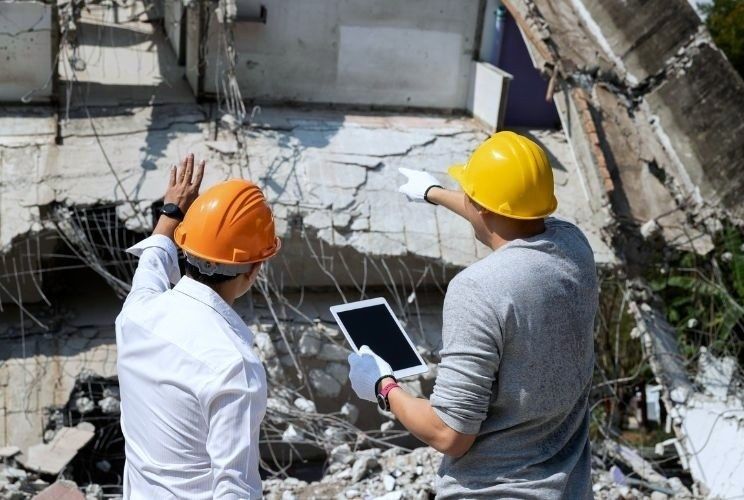
The first priority after a structural or electrical incident is safety. Investigators must assume that damaged members, energized conductors, pressure systems, suspended loads, and fire-damaged equipment may remain unstable. Access routes should be controlled, secondary collapse zones identified, and temporary shoring or isolation installed before detailed examination begins. Electrical hazards require particular care because conductors can remain energized through backfeed, stored energy, automatic transfer equipment, or damaged protection systems. Lockout and verification procedures should be completed by qualified personnel, and combustible atmospheres must be assessed before intrusive work starts.
Evidence can disappear quickly. Weather can alter fracture surfaces, water can wash away contamination, demolition can remove load-path clues, and emergency actions can change the position of components. A forensic team therefore documents the scene through photographs, laser measurements, drawings, witness interviews, equipment logs, alarm records, and carefully controlled removal. Structural investigators commonly preserve both failed and undamaged reference samples so that material condition, geometry, installation quality, and environmental exposure can be compared. The established forensic engineering process treats stabilization, evidence preservation, records review, field examination, laboratory testing, and scenario analysis as connected tasks rather than isolated activities.
- Establish safe access routes and exclusion zones before collecting evidence.
- Isolate electrical, mechanical, hydraulic, gas, and pressure hazards, then verify isolation.
- Record component positions, deformation, burn patterns, environmental conditions, and temporary emergency changes.
- Assign unique identifiers to samples, photographs, test pieces, drawings, and digital records.
- Preserve original data from protection relays, programmable controllers, building management systems, cameras, and alarm panels.
Non-destructive evaluation helps investigators understand an artifact without immediately destroying the evidence. Industrial computed tomography can reveal internal voids, cracks, inclusions, misplaced fasteners, solder defects, and hidden geometry. Three-dimensional X-ray mapping can expose discontinuities inside assemblies that appear intact externally. Ultrasonic testing, radiography, infrared thermography, magnetic methods, dye penetrant inspection, and digital microscopy can then be selected according to the material and suspected failure mode. The sequence matters: investigators generally start with the least intrusive technique, preserve the original condition, and only cut or section a component when the expected information justifies the loss of evidence.
Chain of custody is equally important. A metallurgical fragment, circuit board, cable section, or protective device must be traceable from the scene through packaging, transport, storage, preparation, testing, and final reporting. Labels should identify who collected the item, when and where it was found, its orientation, associated photographs, and any handling restrictions. The same discipline applies to digital evidence. Relay event files, oscilloscope captures, maintenance records, and control-system logs should be copied in a manner that preserves metadata and prevents uncontrolled alteration. Reliable conclusions depend not only on sophisticated instruments, but also on confidence that the tested evidence is the evidence recovered from the incident.
Microscopic and Circuit Level Root Cause Workflows
A visible collapse or burned enclosure is the endpoint of a process, not necessarily the root cause. Structural failure analysis may connect a global deformation pattern to local yielding, fatigue cracking, brittle fracture, corrosion loss, deficient weld fusion, or a connection that could not develop its intended capacity. Investigators compare the observed damage with calculated load paths and realistic boundary conditions. They also test alternative explanations, account for uncertainty in material strength and loads, and examine whether redistribution mechanisms allowed a local defect to become a progressive failure.
Electrical investigations follow a similar logic. A tripped breaker, charred termination, failed insulation system, or damaged semiconductor may be a consequence rather than the initiating fault. Thermal imaging can identify abnormal heat distribution, while spectroscopy and microscopy help characterize residues, oxidation, contamination, and material decomposition. Parametric testing checks whether a component meets expected resistance, insulation, timing, switching, or leakage characteristics. Time-domain reflectometry can help locate discontinuities in cables, and radiography or CT scanning can reveal hidden conductor, connector, or package defects. The strongest findings correlate independent evidence from visual examination, electrical measurements, operating history, protective-device records, and laboratory analysis.
Environmental and operating conditions also deserve disciplined treatment. Heat, moisture, contamination, vibration, and chemical exposure can accelerate insulation degradation or alter material behavior, but correlation alone does not prove causation. Beyond physical component degradation, complex technical investigations must also account for system-level safety barriers, sensor redundancy, and organizational factors. As detailed in the Boeing 737 MAX engineering ethics analysis, relying on single-sensor inputs and failing to ensure robust fault-tolerant software redundancy can compromise safety-critical systems even when individual physical components operate within nominal tolerances. In practice, the investigation must distinguish a primary trigger from cascading overloads. A loose termination may initiate arcing, but the extent of fire damage may then reflect failed overcurrent protection, delayed detection, inadequate compartmentation, or an unavailable backup supply.
- Confirm the failure. Reproduce the reported abnormal behavior under controlled conditions where possible, and document the equipment state, operating parameters, and failure boundaries.
- Localize the fault. Combine thermal imaging, emission or optical methods, radiography, circuit measurements, and component-level testing to identify the most probable physical site.
- Characterize the mechanism. Determine whether the evidence supports fatigue, overheating, dielectric breakdown, contamination, manufacturing error, overload, mechanical damage, or another mechanism.
- Separate trigger from propagation. Reconstruct the sequence and identify which protection, alarm, isolation, or redundancy measures should have stopped escalation.
- Validate the conclusion. Compare alternative hypotheses against independent evidence, reference components, operating records, calculations, and repeatable testing.
This workflow is especially important in modern electronic equipment, where different defects can create similar symptoms. A device may fail electrically because of a damaged bond wire, a cracked package, electromigration, moisture ingress, or a control-system event that exceeded its ratings. Destructive analysis should therefore be targeted rather than automatic. Cross-sections, scanning electron microscopy, chemical analysis, and high-resolution inspection are most useful after non-destructive methods have narrowed the search. The objective is not simply to identify a damaged part, but to determine whether the defect is an isolated consequence or evidence of a wider design, manufacturing, installation, or operating risk.
Translating Catastrophic Incident Data into Modern Building Codes
Investigative agencies such as the National Transportation Safety Board do not merely describe what happened. They model impact mechanics, system performance, human decisions, emergency response, and organizational controls so that other owners can reduce comparable risk. The March 26, 2024, collision between the containership Dali and Baltimore”s Francis Scott Key Bridge illustrates this broader function. The vessel lost electrical power and propulsion, struck Pier 17, and caused a partial collapse that killed six construction workers. In its March 2025 interim report, the NTSB evaluated bridge geometry and design, pier protection and capacity, vessel traffic, waterway characteristics, and related factors.
The assessment concluded that the Key Bridge”s collapse risk from vessel collision exceeded the acceptable threshold established by AASHTO. It also identified 68 other bridges frequented by ocean-going vessels that were built before vessel-collision guidance issued in 1991 and had not been evaluated using recent vessel-traffic data. The significance is not limited to one bridge. As documented in the NTSB collision assessment, vessel-strike evaluations can drive mandatory barrier and protection updates, including vulnerability assessments, short-term operational controls, and longer-term structural risk reduction.
Code development normally proceeds through evidence, recommendation, technical committee review, public comment, adoption, and enforcement. An investigation may reveal that an existing prescriptive rule does not cover a new vessel size, traffic pattern, material system, fault current, or operating environment. Engineers then translate the finding into a performance requirement, design method, inspection interval, protection criterion, or documentation obligation. Adoption is not immediate, and local jurisdictions may modify the timing or scope, so project teams must verify the edition and amendments that legally apply to each site.
The Merrimack Valley gas disaster demonstrates how system configuration and project management can be as important as component strength. In September 2018, high-pressure natural gas entered a low-pressure distribution system in Lawrence, Andover, and North Andover, Massachusetts. The resulting overpressurization contributed to fires and explosions, killed one person, sent 22 people to hospitals, and damaged 131 structures. The incident affected 10,894 customers after the low-pressure system was shut down. The investigation examined engineering processes, operational decisions, emergency response, regulatory oversight, and safety recommendations, reinforcing a central lesson: reliable infrastructure depends on design controls, pressure regulation, records, commissioning, communication, and effective response working together.
Evolution of Safety Factors Across Core Engineering Domains
Historic design practice often relied on nominal loads, simplified failure modes, and assumptions that systems would remain within familiar operating boundaries. Modern practice still uses calculated margins, but forensic findings have expanded the definition of risk. Designers now account more explicitly for accidental actions, degradation, changing demand, common-cause failures, loss of utilities, human interaction, and the possibility that one local failure can redistribute load into an unprepared part of the system.
| Engineering domain | Earlier assumption | Forensic-driven emphasis |
|---|---|---|
| Structural integrity | Design for prescribed loads with limited consideration of abnormal impact or progressive collapse | Robust load paths, continuity, redundancy, deterioration assessment, accidental actions, and scenario-based resilience |
| Gas distribution | Pressure control and component compliance treated as the primary safeguards | Independent regulation, configuration management, verification of records, automatic protection, emergency isolation, and coordinated response |
| High-voltage circuits | Equipment selected mainly for nominal voltage and expected load | Short-circuit withstand, insulation coordination, arc-flash risk, selective protection, grounding, environmental derating, monitoring, and maintainability |
Safety factors are therefore only one part of resilience. A system with strong individual members can still fail if isolation is slow, access is poor, alarms are ignored, or backup equipment shares the same vulnerability. Dynamic redundancy means that alternate paths, protective devices, communications, and operating procedures remain available when the primary path is impaired. Current code-based practice increasingly combines capacity requirements with mitigation measures that limit consequences, support evacuation, preserve critical functions, and make inspection results actionable.
For project teams, this means matching the solution to the real load and environment rather than selecting equipment from a nominal rating alone. High-voltage equipment must be evaluated for fault duty, enclosure conditions, clearances, coordination, maintenance access, and expected future expansion. Structural and gas systems require the same discipline applied to different hazards. The aim is not unlimited conservatism, which can create cost and constructability problems, but transparent risk control supported by calculations, inspection, testing, and documented assumptions.
Building Resilient Systems Through Forensic Discipline
Compliance codes should not be treated as bureaucratic friction. They are institutionalized incident memory. Each requirement reflects a judgment about acceptable risk, available technology, human behavior, and the consequences of failure. The value of a code is realized only when designers, installers, inspectors, operators, and owners understand the failure mechanism the requirement is intended to prevent.
- Review past incidents relevant to the structure, equipment, hazard, and operating environment.
- Document design assumptions, load cases, protection settings, environmental limits, and inspection access.
- Use independent design checks for critical load paths, protective coordination, pressure control, and emergency isolation.
- Preserve commissioning data and establish a reliable baseline for future condition assessments.
- Test alarms, interlocks, backup supplies, and emergency procedures under realistic conditions.
- Feed maintenance findings, near misses, and abnormal operating events back into specifications and risk reviews.
The practical objective is straightforward: get the fundamentals right first, then examine how the system behaves when those fundamentals are challenged. Proactive forensic thinking does not require waiting for a collapse or fire. Design teams can ask which component is most likely to degrade, what evidence would reveal that degradation, which protection should operate first, and whether a single fault could defeat several safeguards at once. For critical civil and electrical infrastructure, that discipline improves safety, reduces avoidable downtime, supports defensible compliance decisions, and turns past failures into better-performing systems.