
Design for Demanufacturing: How Reversible Fasteners and Optical Sorting End Shredder E-Waste
-
Posted in : Uncategorized:
- On : Nov 14, 2026
Moving Beyond the Mechanical Violence of E-Waste Shredding
Most electronic recycling systems still begin with a destructive step. Devices are collected, manually pre-processed to a limited extent, and then sent through shredders that reduce housings, circuit boards, batteries, fasteners, and wiring to a mixed fraction. Downstream separation can recover steel, aluminium, copper, and some precious metals, but the process permanently destroys the original assembly. Small integrated circuits, connectors, sensors, displays, and battery modules that could have been reused or refurbished become difficult to identify and often lose much of their functional value.
This approach conflicts with the broader lifecycle principle described by the US EPA electronics stewardship guidance and reinforced by an Authoritative Source from the European Commission. Electronics stewardship covers material sourcing, environmentally preferable design, durable use, repair, refurbishment, collection, and recycling. Recycling remains important, but it should be the final recovery route after higher-value options such as direct reuse, component harvesting, and remanufacturing have been assessed.
Design for Demanufacturing, or DfD, changes the starting point. Instead of treating a finished product as an inseparable object, engineers define it as a controlled sequence of modules that can be opened, released, identified, and routed by machines. Reversible fasteners, standardized snap-fit geometries, accessible extraction paths, and optical fiducials allow robotic systems to separate assemblies without unnecessary damage. Gold-plated contacts, lithium-containing cells, rare-earth magnets, power semiconductors, and high-value processing boards can then remain in identifiable and potentially functional form. The result is not simply less waste. It is a more controlled material and component supply chain.
Active Disassembly Using Shape Memory Alloys and Thermally Reversible Fasteners
Active Disassembly using Smart Materials, commonly associated with ADSM research, uses a deliberate stimulus to release a joint. That stimulus may be heat, an electromagnetic field, or another controlled input. A product can therefore contain fasteners that remain secure during ordinary use but release at a defined processing condition. In a demanufacturing cell, one thermal cycle could activate dozens of joints simultaneously, reducing the need for a robot to locate and remove every individual screw.
Nickel-titanium, usually called Nitinol, is attractive for this purpose because its shape memory effect can produce repeatable movement when the material passes through a transition temperature. A Nitinol clip or actuator can pull a latch clear of an enclosure wall, provided that the thermal profile is carefully controlled. The design must account for recovery force, fatigue over repeated cycles, corrosion protection, electrical isolation, and the temperature limits of nearby batteries, displays, adhesives, and polymer components. Thermal expansion alone is not enough; the actuator must generate sufficient force while avoiding distortion of the chassis or shock loading of the circuit board.
Thermally degradable or reversible polymers offer a different tradeoff. A reversible hot-melt adhesive can soften or debond at a controlled temperature, potentially separating a display, battery, or cover without the residue associated with many permanent pressure-sensitive adhesives. However, process windows must be validated carefully. Excess heat can damage solder joints, warp thin housings, accelerate battery failure, or contaminate optical surfaces. Permanent adhesives remain useful where sealing, stiffness, or ingress protection is essential, but they should be limited to locations where repair and recovery are not practical.
| Joining method | Primary benefit | Engineering concern |
|---|---|---|
| Nitinol actuator | Repeatable mechanical release from a controlled trigger | Temperature control, fatigue, force, and isolation |
| Reversible hot-melt | Broad-area bonding with heat-triggered separation | Residue, thermal exposure, and bond ageing |
| Permanent adhesive | High stiffness and sealing performance | Slow, destructive removal and contamination risk |
| Conventional screw | Known service method and strong clamping | Tool access, cycle time, and fastener loss |
The operational advantage is significant. Manual screw removal can take minutes per device, especially when several drive sizes, hidden fasteners, or adhesive layers are involved. A validated thermal chamber or localized induction station can release a batch in seconds, after which a robot lifts modules along predefined trajectories. This does not remove the need for inspection. Operators and control systems must still verify that the structure has released, that no battery has swollen, and that sensitive boards are supported before extraction. Automated teardown cells also require precision harvesting equipment and reliable component handling protocols so that released assemblies are protected rather than damaged during transfer.
Standardizing Cantilever Snap-Fits for Non-Destructive Robotic Release
Snap-fits can be highly effective in DfD when their geometry is designed for predictable release rather than merely fast assembly. A cantilever snap-fit uses a flexible beam, an undercut, and a hook or retaining feature. An annular snap-fit uses hoop strain around a circular feature and can support enclosure retention or sealing. Both mechanisms should provide a clear release direction, visible or machine-detectable access, and enough compliance to tolerate normal dimensional variation without requiring excessive force.
Material selection and geometry must be considered together. PC-ABS may provide a practical balance of toughness, impact resistance, and mouldability for consumer enclosures, while bio-based polyesters may require closer examination of brittleness, moisture sensitivity, creep, and temperature performance. Cantilevers should generally be tapered, their bases should be filleted to reduce stress concentration, and the intended deflection should remain within a validated strain limit for the selected resin. The joint must survive impact, vibration, and thermal cycling, then release under a calibrated directional force at end of life.
Prototyping can expose failure modes early. Guidance for printed snap-fit development identifies nylon, ABS, and PETG as useful tough and ductile materials, while SLS PA12 is often suitable for functional prototypes and repeated cycling. Nominal clearances vary with the process, with approximately 0.5 millimetres commonly used as a starting point for FDM prototypes and approximately 0.3 millimetres for SLA, SLS, and MJF designs. These are not universal production values. Injection-moulding shrinkage, resin conditioning, tool wear, assembly temperature, and accumulated tolerance must be confirmed through testing.
- Provide a standardized push-pin or probe port that leads directly to each release tab.
- Use alignment lugs to transfer shear loads instead of loading the flexible cantilever.
- Keep release surfaces free from cables, labels, ribs, and decorative covers.
- Use directional force limits that prevent housing fracture and protect nearby boards.
- Cycle-test the joint after impact, vibration, humidity, and thermal exposure.
A practical architecture separates the loads. Rigid lugs or guides carry enclosure alignment and impact forces, while the snap beam supplies retention and can be released by a robot. This prevents the flexible feature from becoming the sole structural member. Push-pin access ports should be standardized across a product family so that an end-effector can use one calibrated stroke and force profile. The objective is not to make every enclosure weak or permanently openable. It is to make normal use secure and controlled end-of-life release repeatable.
Vision-Guided Optical Sorting and Near-Infrared Material Identification
Once modules are released, the demanufacturing system must know what it has recovered. Hyperspectral imaging and short-wave infrared sensors can distinguish materials by their spectral response, including many mixed flame-retarded polymers that appear identical to ordinary cameras. A conveyor-mounted system can combine shape, colour, reflectivity, and spectral data to classify parts in milliseconds. That information can direct polymer housings, elastomers, aluminium shields, copper assemblies, batteries, and printed circuit boards into separate process streams.
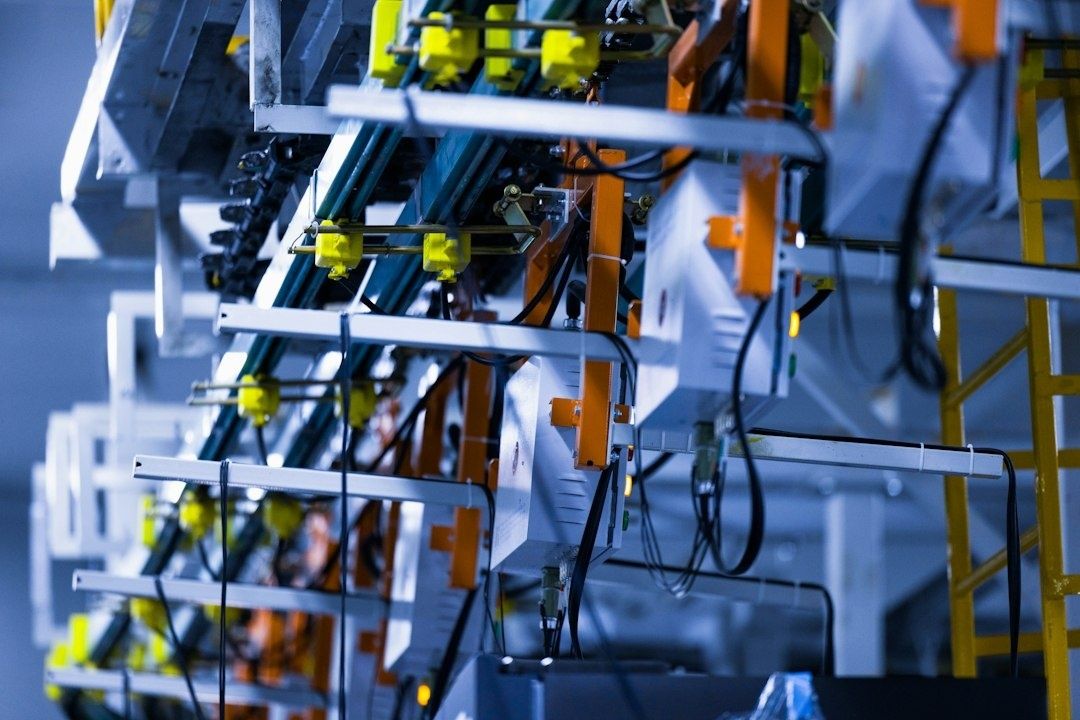
Optical identification becomes more reliable when the product itself provides machine-readable information. Fiducial markers can define coordinate systems for a robot, while standardized digital watermarks or QR-coded PCB subassemblies can identify revision, material family, battery type, or handling restrictions. Markers should remain visible after ordinary wear and should be placed where a camera can inspect them before a gripper approaches. A code is useful only when it is linked to an accurate bill of materials and an up-to-date disassembly recipe.
Edge computing allows classification to occur close to the machine rather than relying entirely on a remote service. Neural networks can be trained on images of real teardown states, including partially opened products, damaged labels, missing fasteners, swollen pouch cells, and boards viewed at different angles. The model can flag a suspected lithium-ion hazard, identify a valuable surface-mounted integrated circuit, or instruct the cobot to change its grip. Human review remains appropriate for uncertain or dangerous cases, particularly where a battery is punctured, deformed, hot, or electrically unstable.
- Capture an initial image and identify the product family, orientation, and hazard state.
- Locate fiducials, access ports, fasteners, cables, and module boundaries.
- Release and remove the highest-risk or highest-value module first, following the validated sequence.
- Scan each recovered part with visible and infrared data before routing it to a material stream.
- Record the result in a traceability system for quality control and process improvement.
Purity above 99 percent may be technically achievable for selected recovered thermoplastic or metallic fractions when feedstock is controlled, sensors are calibrated, and contamination is limited. It should not be treated as an automatic outcome for every waste stream. Performance depends on product mix, dirt, coatings, black plastics that absorb infrared light, sensor resolution, line speed, and the quality of the classification model. Standards and research initiatives are increasingly connecting ecodesign, traceability, material separability, and recycling. This direction is reflected in the European Commission”s regulatory framework for the Ecodesign for Sustainable Products Regulation.
Mechanical Design Decisions for Automated Component Harvesting
Automation performs best when mechanical variation is removed at the design stage. A product bill of materials should use as few fastener drive geometries as practical, with consistent head access and a defined torque range. This avoids frequent tool changes and reduces the risk of applying the wrong bit to a fastener. Where screws are necessary, captive designs can prevent loose hardware from entering conveyors or damaging boards. Where a snap-fit is sufficient, the release port and force direction should be documented in the same way as a screw location.
Unobstructed z-axis trajectories are equally important. A battery, display, speaker, or logic board should lift vertically or follow a known path without first requiring lateral twisting. Cables should be routed through dedicated channels, with connectors oriented toward the extraction side and enough finger or gripper clearance around their latches. Flexible cable loops, adhesive flags, and wire retainers can create entanglement points that are inexpensive to eliminate during design but costly to manage in a robotic cell.
- Use a single reference datum for enclosure opening, board location, and robot calibration.
- Separate fragile connectors from primary gripper contact zones.
- Provide mechanical stops that prevent a tool from pressing into a battery pouch or display.
- Keep high-value boards free from permanent adhesive wherever practical.
- Document force, stroke, temperature, and sequence limits for every automated release.
Lithium-ion pouch cells require special treatment. They should be isolated from sharp edges, high-force probing, and uncontrolled thermal exposure. A battery module should have a dedicated removal path, electrical isolation provisions, and a detection step for swelling or deformation before extraction. The safest sequence may be different from the sequence that maximizes immediate material throughput. A damaged cell must be diverted according to the facility”s approved safety procedure rather than forced through a standard gripper cycle.
Modularity also improves both repair and recovery. Ports, batteries, displays, cameras, and speakers are frequent failure points and should be replaceable independently from high-value processing logic boards. Keeping these assemblies separate enables warranty service, refurbishment, component grading, and material recovery without destroying the entire device. Reliability analysis should guide the boundaries: components with high failure rates or short technology cycles deserve accessible modules, while sealed assemblies should be reserved for functions that genuinely require permanent protection.
Building the Future of Circular Electronics Engineering
Reversible fasteners and optical robotics turn circular economy objectives into concrete shop-floor controls. A Nitinol actuator, a thermally reversible bond, or a well-designed cantilever snap-fit is valuable only when its release force, access direction, and environmental limits are specified. Likewise, a camera system becomes useful when fiducials, material codes, hazard states, and extraction recipes are designed into the product rather than added after manufacturing.
The economic case is practical as well as environmental. Easier access can reduce warranty service time, lower the risk of collateral damage during repair, and improve the yield of refurbished modules. At end of life, cleanly separated batteries, boards, polymers, metals, and reusable components create higher-value secondary streams than a mixed shredder fraction. Mechanical and electrical systems designers should therefore treat end-of-life disassembly with the same discipline applied to high-speed assembly: define the sequence, control the forces, verify the interfaces, record the result, and design every critical step for reliable repetition.